
Mid-Budget vs Luxury:
What Are You Actually
Paying For?
This guide covers Kenya specifically — the Masai Mara, Amboseli, Samburu, Laikipia, and the private conservancies that border the Mara. Between a $300–$700-a-night mid-budget property (shoulder season — expect 30–40% more at peak) and a $1,500-a-night luxury camp, the question isn’t just about comfort — it’s about what each dollar actually buys you in the Kenyan bush.
The honest answer is more nuanced than most travel blogs admit. Mid-budget doesn’t mean roughing it, and ultra-luxury doesn’t always mean a better wildlife encounter. At Wanderlust Expeditions, we plan safaris across the full range — and we’ve seen both ends deliver extraordinary experiences, and both disappoint when the fit isn’t right. Here’s what really separates the two, and where the spending genuinely matters.
Accommodation
The Camp Experience: More Than Just a Bed
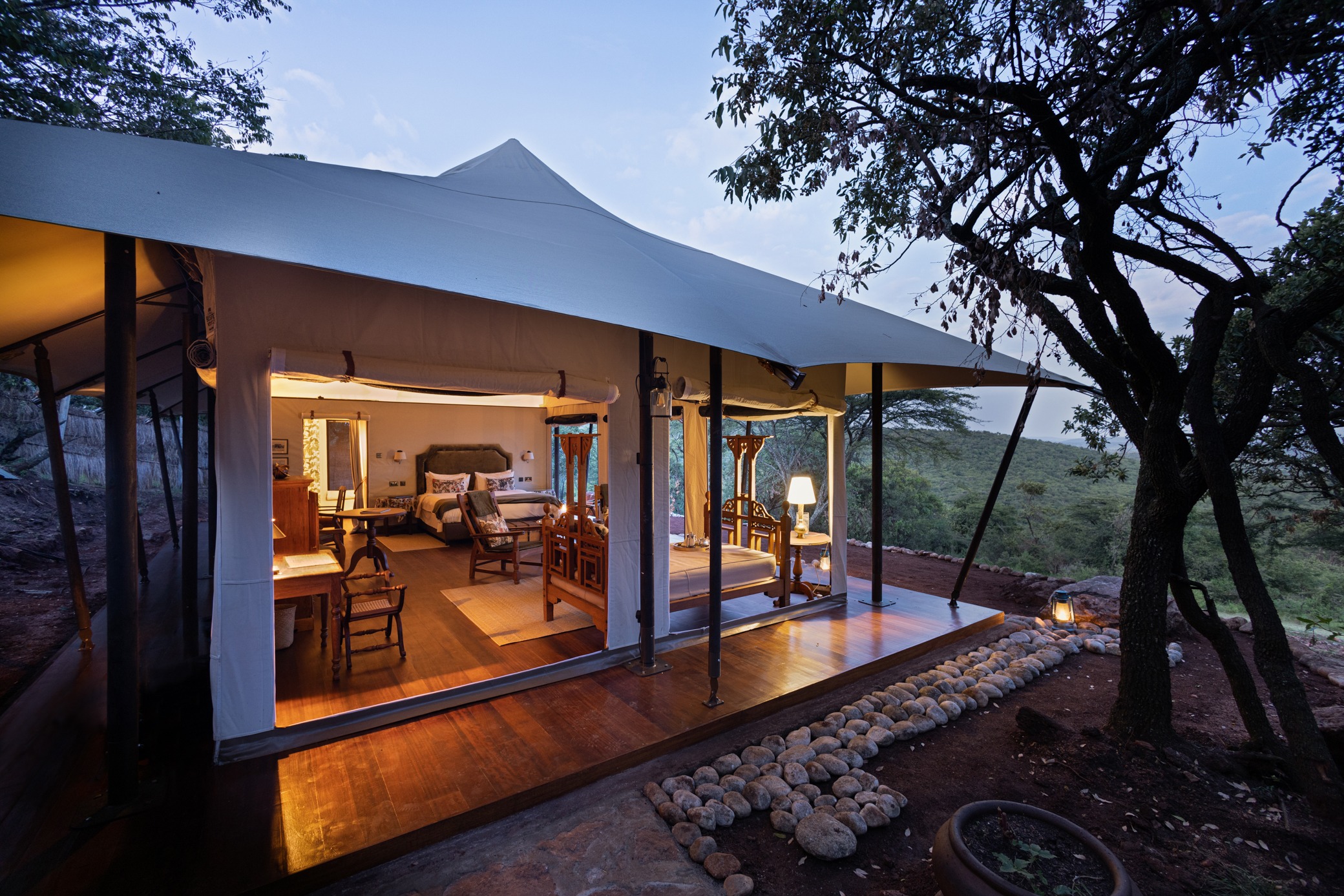
Let’s start with the biggest misconception: mid-budget does not mean roughing it. Kenya’s mid-range camps include some genuinely excellent properties — boutique tented camps with proper canvas-and-wood structures, attentive service, good food, and that irreplaceable sensation of falling asleep to the sounds of the African night with nothing but canvas between you and the bush. Porini Mara, Rekero, Mara Siligi, Basecamp Masai Mara — these are not compromise options. They deliver a real, intimate, memorable safari experience.

Comfortable beds at the upper mid-budget Porini Mara Camp. Photo: Porini Mara Camp
Mid-budget camps also vary considerably in style. Some are classic tented camps with a camp-like rhythm — communal meals, shared fire, game drives that feel like an adventure. Others are more lodge-based, with permanent structures, swimming pools, and a slightly more hotel-like feel. Neither is better; it’s a question of what kind of experience you’re after.

Boutique mid-budget camp tent. Photo: Mara Siligi Camp
Where Luxury Pulls Away
The gap opens decisively when you step into a top-tier property. Luxury safari camps in Kenya — think Mahali Mzuri, Angama Mara, Cottar’s 1920s Camp, or Sanctuary Olonana — operate on a different register entirely. Freestanding copper bathtubs with a view of the plains, outdoor rain showers open to the sky, full lounge areas with daybeds and writing desks, walk-in closets, plunge pools overlooking game-rich valleys, curated minibars, and butler service that anticipates before you ask — essentially a private villa that happens to be in the African bush.
The bathroom is often the clearest signal. A luxury camp gives you an outdoor shower under a canopy of stars while zebra graze twenty metres away. That experience — sky above you, bush around you — is something mid-budget camps don’t typically offer, though the canvas walls and African night sounds are very much part of both tiers. The difference is real — but it’s the difference between very good and extraordinary, not between acceptable and good.

Outdoor Shower in Asilia’s Naboisho Camp. Photo: Debashri Sengupta

Living Room at Enkewa Camp. This tent also has a separate, walk-in closet and a large bathroom area. Photo: Debashri Sengupta

Luxury accommodation. Photo: Debashri Sengupta
Game Drives
The Vehicle Question: Shared or Private?
This is, for many travellers, the most consequential practical difference between tiers — and one that’s often glossed over in brochures.
At mid-budget camps, game drives are typically conducted in shared vehicles with four to six other guests. The vehicles are usually well-maintained open-sided 4x4s, guides are experienced and knowledgeable, and you follow designated tracks within the reserve. It’s a good experience — sometimes a great one.
It’s worth being clear about something the industry doesn’t always say directly: exclusive vehicles are not a standard feature of luxury camps. Many luxury properties still operate shared vehicles — it is only at the ultra-luxury end that private vehicles become the norm. At mid-budget, private vehicle hire is usually available as an add-on — typically $300–$500 per day. If a private experience matters to you, this is often the most cost-effective upgrade you can make, at any camp tier.
Where a private vehicle does make a meaningful difference: the guide can linger at a sighting as long as you want, time departures around your interests, and have a genuine, unhurried conversation with you — rather than managing six people’s questions simultaneously.

Photo: Debashri Sengupta
The Guide
Make or Break: Why the Guide Matters Most
Here is something the industry rarely admits openly: the quality of the guide matters more than the quality of the vehicle, the camp, or the budget tier. A brilliant naturalist in a shared mid-budget vehicle will deliver a more meaningful safari than a mediocre guide in a private luxury Land Cruiser. We’ve seen it repeatedly, and it’s the single variable most travel agents fail to account for when they book.
The good news is that Kenya has some extraordinary guides working across all budget levels. Some of the finest naturalists in the Mara ecosystem work at mid-budget conservancy camps — people who have spent decades reading specific landscapes, know individual animals by behaviour, and can interpret what’s happening around you in ways that transform a game drive into something close to a masterclass.
The frustrating reality is that guide quality is inconsistent at every tier. At Wanderlust Expeditions, matching you with the right guide is treated as seriously as matching you with the right camp. It is not an afterthought.

A Guide is probably the most important element in your entire safari. Photo: Porini Camps
Location
Conservancies vs the National Reserve: Two Different Kenyas
This is where budget tier and location intersect in ways that matter enormously for your actual experience — and where the luxury premium often delivers its clearest return on investment.
The Masai Mara National Reserve is where most mid-budget camps operate. It’s a magnificent ecosystem — the most famous wildlife destination in Africa for good reason. But it is also, particularly during peak Migration season (July to October), extremely busy. Vehicle numbers at river crossings can reach absurd levels. It is still a profound experience — but the sense of solitude that many people associate with African safari is harder to find here at peak season.
The private conservancies that border the Reserve — Olare Motorogi, Naboisho, Ol Kinyei, Mara North, Lemek, and others — operate under a different set of rules. Vehicle numbers are strictly capped. Off-road driving is permitted. Night drives and bush walks become possible. And because these conservancies are run in partnership with local Maasai communities, they carry a conservation and cultural dimension that the National Reserve cannot match.
Access to the conservancies is, with a few exceptions, primarily through luxury and upper-mid properties that have acquired conservancy concessions. This is perhaps the strongest argument for spending more in Kenya: it’s not just about a better tent. It’s about a fundamentally different landscape and a fundamentally different quality of wildlife encounter.
That said — Porini Mara Camp operates in Ol Kinyei Conservancy at mid-budget rates. Mara Siligi operates in a private conservancy. These are exceptions worth knowing about, and they represent some of the best value in Kenyan safari.

Intimate wildlife experience in Naboisho Conservancy. Photo: Debashri Sengupta
Beyond the Mara
Amboseli, Samburu & Laikipia
Kenya is more than the Masai Mara, and the budget calculus shifts depending on where you go.
In Amboseli — famous for its elephant herds and Kilimanjaro views — mid-budget options like Ol Tukai Lodge and Amboseli Serena deliver a genuine experience at reasonable rates. The park is smaller and more manageable than the Mara, which means less competition for sightings and a more relaxed atmosphere overall.
Samburu, in northern Kenya, has a different character entirely: drier, more remote, with a distinct suite of wildlife found nowhere else in Kenya — the ‘Special Five’ (Grevy’s zebra, reticulated giraffe, Beisa oryx, Somali ostrich, gerenuk). Both mid-budget and luxury options exist here, and the experience is excellent at both levels because the destination itself is less visited and the wildlife encounters tend to be more intimate regardless of camp tier.
Laikipia Plateau, northwest of Mount Kenya, is one of Africa’s great conservation success stories and home to some of Kenya’s finest wildlife properties. It’s predominantly luxury territory — Ol Pejeta Conservancy, Lewa Wildlife Conservancy, Borana, Ol Jogi — though mid-budget options exist and the rhino encounters here are extraordinary.

Soroi Larsen’s Camp, Samburu. Photo: Soroi Larsen’s Camp
The Top of the Market
Ultra-Luxury: White Gloves, Separate Luggage Vehicles & the Question of Whether It Matters
Above the standard luxury tier sits a small category of properties where the experience becomes genuinely theatrical: Cottar’s 1920s Camp, Segera Retreat, Ol Jogi, the Angama properties. Prices here typically start at $1,500 per person per night and climb well above $2,000. Private chefs, private guides, private vehicles as a matter of course, and a level of personalisation that extends to pre-arranged surprises, private dinners in the bush, and itineraries built entirely around your interests.
Does it translate to better wildlife? Not necessarily. Does it translate to a more extraordinary overall experience? For the right person, absolutely. These are properties for travellers for whom the setting, the service, and the storytelling are as important as the sightings — for whom a safari is not just a wildlife encounter but a complete sensory and emotional experience from first arrival to final departure.
We don’t push this tier on anyone who doesn’t specifically want it. But we’re very good at identifying when it’s exactly the right fit — and when it isn’t.
The Sundowner Ritual
One ritual unites every tier of Kenyan safari: the sundowner. As the light turns golden and the game drives wind down, vehicles stop somewhere with a view — a kopje, a riverbank, an open plain — and drinks are poured. This is not exclusively a luxury experience. Some mid-budget camps go all-out. Mara Siligi, for example, sends a separate vehicle ahead to set up the sundowner before you arrive — a full spread of drinks, freshly prepared hot snacks, a bonfire already lit, and a butler on hand. You pull up to find everything ready, the plains stretching out in front of you, the fire crackling. It is, by any measure, extraordinary.
At the luxury end, the production values are higher — linen napkins, something sparkling, a table set in the bush — but the fundamental magic is the same at every level. The bush doesn’t care what’s in your glass. And the light, at that hour, is the same for everyone.

Sundowner in the Masai Mara. Photo: Debashri Sengupta
At a Glance
How They Stack Up
| Mid-Budget | Luxury | Ultra-Luxury | |
|---|---|---|---|
| Nightly Rate | $300–$700 ppShoulder season — 30–40% higher at peak | $700–$1,500 pp | $1,500–$2,500+ pp |
| Tent Quality | Tented camps or lodges; comfortable, en-suite, well-run | Spacious designed interiors, bathtub or outdoor shower | Exceptional suites; plunge pool, butler, bespoke finishes |
| Exclusive Vehicle | Add-on ($300–500/day)Shared vehicles included in rate | Usually shared; private available as add-onConfirm when booking | Private vehicle typically standard |
| Guide Quality | Good to excellent; variable — some of Kenya’s finest guides work at mid-budget camps | Consistently strong; experienced | Elite; deep territorial and animal knowledge |
| Night Drives | Conservancy camps onlyNot permitted in the National Reserve | Conservancy camps onlyNot permitted in the National Reserve | Conservancy camps onlyNot permitted in the National Reserve |
| Off-Road Driving | Conservancy camps onlyNot permitted in the National Reserve | Conservancy camps onlyNot permitted in the National Reserve | Conservancy camps onlyNot permitted in the National Reserve |
| Walking Safaris | Rare | Some camps offer | ✓ Often included |
| Conservancy Access | Some mid-budget camps inside conservancies | Many are in conservancies; some in the Reserve | Varies — some in conservancies, some in the Reserve |
| Luggage Vehicle | ✗ | ✗ | Some properties — yes |
| Wildlife Access | Determined by location and guide, not budget. A well-placed mid-budget camp in a prime conservancy equals any luxury property on game sightings. Porini Camps, for example, sit at the upper end of mid-budget and operate inside Ol Kinyei and Olare Orok — some of the most productive wildlife habitat in the entire Mara ecosystem. | ||
The Bottom Line
So Which Should You Choose?
The honest answer: it depends on what matters most to you — and what kind of experience you want to have.
If you want the best possible wildlife encounters within a budget, a well-chosen mid-budget camp in a good location with a strong guide will deliver something extraordinary. Kenya is generous with its wildlife, and you don’t need to spend $1,500 a night to have a life-changing safari.
If the total experience matters — the setting, the service, the food, the sense of complete immersion — and your budget allows, a luxury conservancy camp will give you something that goes beyond the wildlife itself. The best of these properties don’t just show you Africa — they make you feel like you belong in it, at least for a week.
And for many travellers, the answer is both: a night or two at a mid-budget camp for the energy and the value, combined with a stay at a luxury conservancy for the depth. We design a lot of itineraries this way, and it tends to produce the most well-rounded, satisfying Kenya experiences we see.
Choose Mid-Budget If…
You want maximum nights in the bush, are travelling with a larger group, or want a first safari that delivers everything that matters at sensible cost.
Choose Luxury If…
Exclusivity, conservancy access, and the total quality of experience matter as much as the wildlife itself.
Consider Both If…
You want the energy of the Mara and the intimacy of a conservancy — combining tiers often produces the most complete Kenya experience.
Talk to Us If…
You’re not sure which fits. Matching the right experience to the right traveller is what we do. Tell us who you are and we’ll tell you where to go.
Plan Your Safari
Wanderlust Expeditions
East Africa & India Specialists
We are a US-based company specialising in East Africa and India — conservation-focused, ethically grounded, and deeply connected to the operators and guides who know these destinations best.
Every itinerary we design starts with one question: what do you actually want to feel when you’re out there?